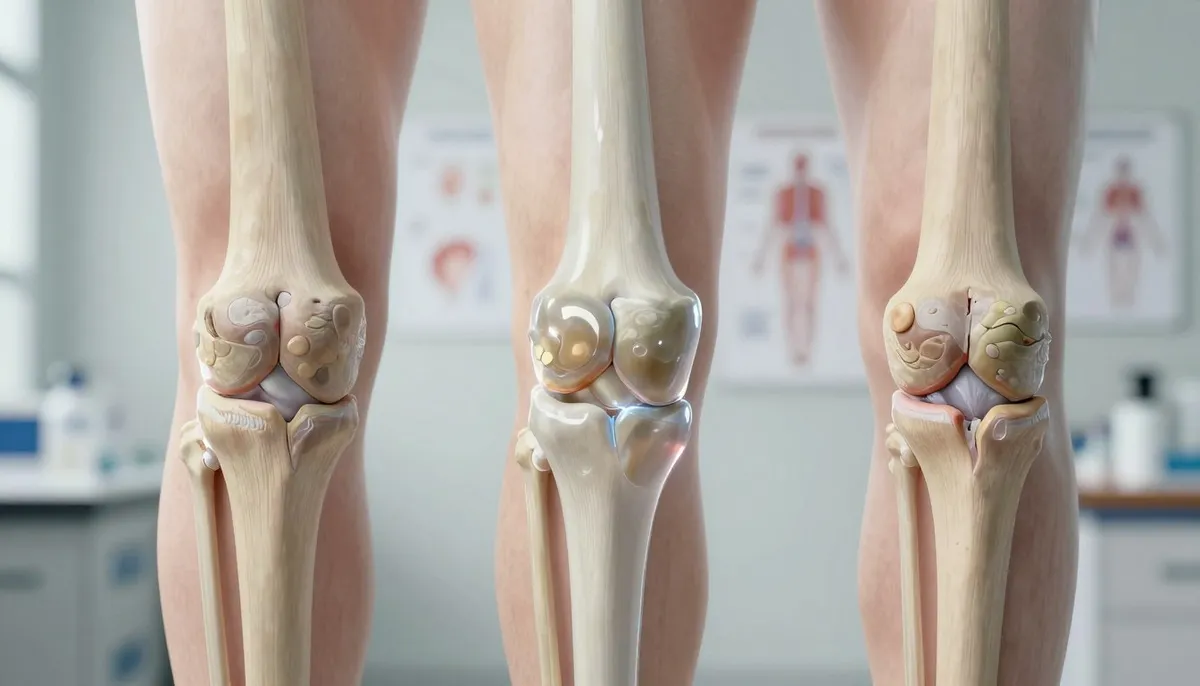
"My knees just don't glide like they used to." That feeling of stiffness, grating, and give-up impact is often not just worn cartilage. It is thinner joint fluid. From around age 30, the body makes less of the one molecule responsible for that fluid's thickness, and the enzymes that break it down keep working. The result is fluid that no longer cushions the way it once did.
This guide explains the molecule (hyaluronan), the numbers that separate healthy fluid from degraded fluid, and what the clinical evidence actually supports for protecting and rebuilding joint cushioning after 60. It is the mechanism-level companion to our overview of what synovial fluid is and why it protects knee and hip cartilage.
The 60 Second Version
- Healthy synovial fluid holds 3 to 4 mg/mL of hyaluronan. Below that, the fluid is too thin to buffer impact.
- Human joint hyaluronan averages about 7 MDa per molecule, roughly 20,000 sugar units long, which is what gives it shock-absorbing power.
- A 70 kg person carries about 15 grams of hyaluronan, and replaces one third of it every day. Aging slows that turnover.
- Cartilage has no blood supply. It gets oxygen and nutrients only from the fluid surrounding it, so thin fluid starves it, not just squeaks it.
- Movement is the pump. Cartilage squeezes fresh fluid out with each step ("weeping lubrication"); long sitting lets joints stagnate.
- Injections are FDA-approved for knee OA, but the evidence is mixed. A 2012 review found little benefit; a 2020 meta-analysis found high-molecular-weight hyaluronan improved pain and function.
What Synovial Fluid Actually Does Inside Your Joints
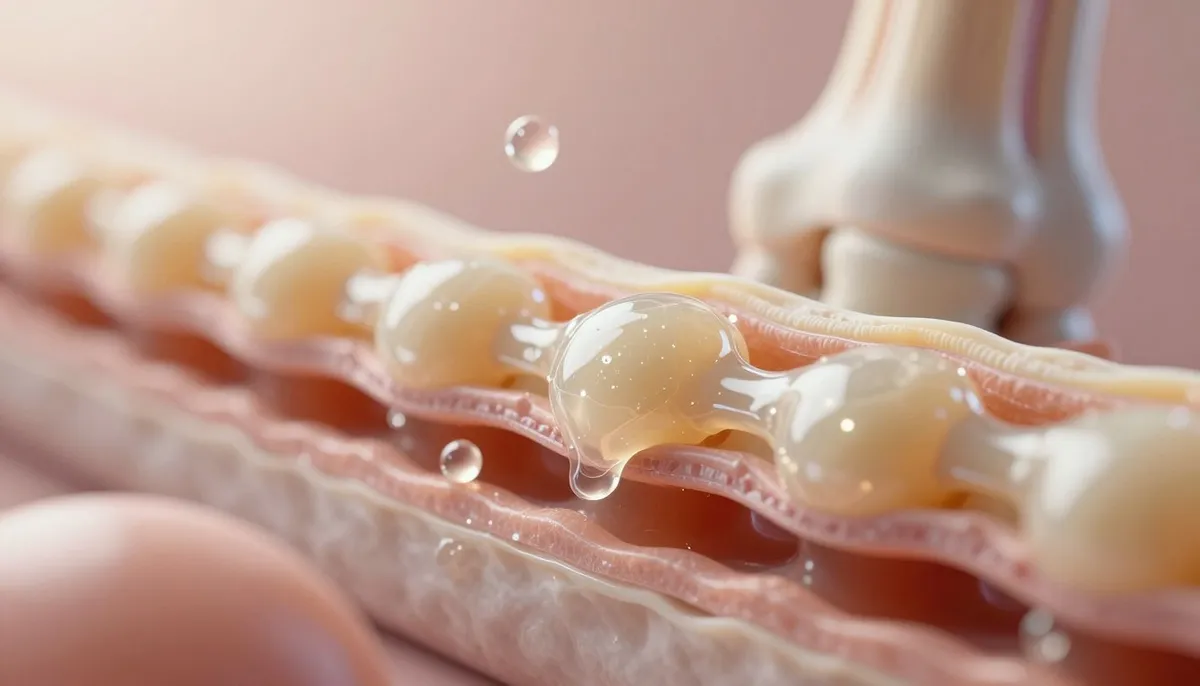
Synovial fluid is a clear, egg-white-like liquid secreted by the synovial membrane into the spaces of the body's synovial joints, the knees, hips, shoulders, and ankles. Its job is to cut friction to near zero and to absorb the shock of every step, so the cartilage-coated bones never grind directly on each other.
It is not a passive lubricant like oil. It is a non-Newtonian fluid, which means its behavior changes with the force applied. Under a sudden load, such as landing from a step, the hyaluronan in it clumps and the fluid thickens instantly to act as a shock absorber. The moment the pressure drops, it thins back out to glide smoothly. That on-demand switching is the whole point of the molecule, and it is what "cushioning" really means.
The fluid does four distinct jobs at once, each tied to a measurable property:
- Friction reduction: the hyaluronan plus a second lubricant called lubricin (proteoglycan 4, or PRG4) form a boundary layer so smooth that the joint's coefficient of friction is about 10 times lower than that of well-oiled machinery.
- Shock absorption: the fluid thickens under shear (a property called rheopecty), buffering impact across the joint surface.
- Nutrition and waste removal: articular cartilage has no blood vessels at all. Chondrocytes, the cells inside the cartilage, receive oxygen and glucose, and dump carbon dioxide, entirely through this fluid.
- Molecular sieving: pressure forces the large hyaluronan chains against the synovial membrane, creating a barrier that keeps the fluid and cells from leaking out of the joint.
Because the fluid is the only way cartilage gets fed, the health of the cushion and the health of the cartilage are the same system. Thin fluid is not merely a squeak. It is a starvation signal.
Why Joint Fluid Thins After Age 30, and Worsens After 60
Two processes run at the same time. The synovial membrane's type B cells, the factory that manufactures hyaluronan, slow their output as you age, while the degrading enzymes called hyaluronidases keep chewing the chains into shorter, weaker fragments. You end up with less of the molecule, and what remains is shorter and less able to hold water.
The size matters more than people realize. The shock-absorbing power of hyaluronan comes from the length of its chain. In a healthy adult joint, a single hyaluronan molecule averages about 7 million daltons (7 MDa), or roughly 20,000 repeating sugar units. Some studies put the typical figure at 3 to 4 MDa, but even the lower number is an enormous molecule by any standard.
Here is the twist that most popular articles miss: with age, the total amount of hyaluronan in cartilage can actually go up, while the size of each molecule goes down. So a knee can be sitting on a pile of short, fragmented hyaluronan that simply cannot hold water or absorb impact the way long chains do. The problem is not always "too little." It is often "too short."
The body still turns over a large share of this molecule every day. A 70 kg person carries about 15 grams of hyaluronan, and degrades and rebuilds roughly one third of it daily. That high turnover is why the system can fail quietly: the damage is continuous and self-reinforcing, because the short fragments produced by degradation further disrupt the very cells that make new long chains.
By your sixth decade, the cumulative effect is visible. What began as a small age-related slowdown in synthesis around 30 compounds into the stiffer, grater, less responsive joints that define the "after 60" experience. The window to intervene is still open, which is why the mechanism above matters.
The Signs Your Synovial Fluid Is Losing Its Grip
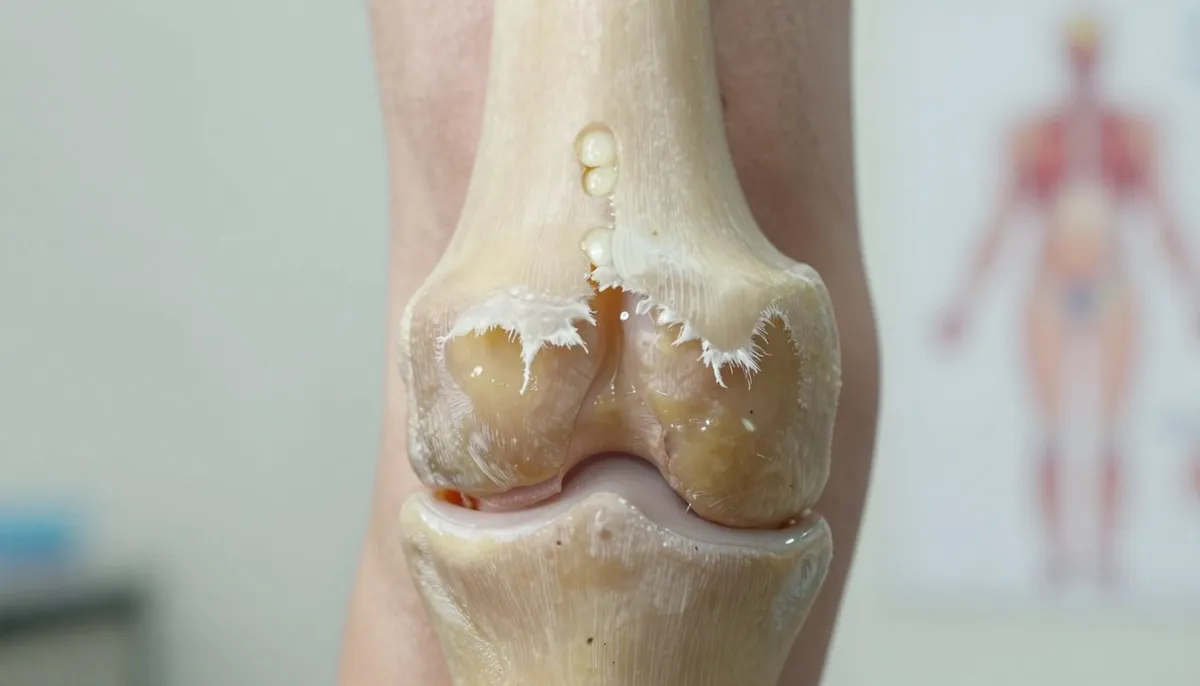
The hallmarks are a joint that aches with use and eases with rest, swelling after activity, a reduced range of motion, and a grating or crackling feel. The most useful marker is morning stiffness that lasts under 30 minutes, which points toward a mechanical, wear-driven problem like osteoarthritis rather than an inflammatory one.
The U.S. National Library of Medicine describes the classic presentation this way, and the pattern is consistent across the major health bodies:
- Pain that comes on with movement and typically improves with rest.
- Stiffness especially in the first 30 minutes after waking or after sitting, which then eases as you move.
- Swelling or a feeling of fullness in the joint after heavy use.
- A joint that no longer bends as far, or that feels loose and unstable.
- A grinding, rubbing, or cracking sensation as the joint moves.
That last point is a useful diagnostic fork, and it is the kind of detail that separates a real assessment from a generic "your joints are aging" article. Both osteoarthritis and inflammatory arthritis cause morning stiffness, but the duration is the tell. Stiffness that clears in under 30 minutes is characteristic of osteoarthritis, the wear-related kind that this guide addresses. Stiffness that lasts well past an hour, often in the small joints of the hands and feet symmetrically, should make an inflammatory cause like rheumatoid arthritis the first thing to rule out, because the treatment path is completely different.
One more marker worth naming: the fluid itself. When a clinician aspirates a joint and analyzes it, normal fluid is clear and straw-colored, high in viscosity, with a white-cell count under 200 per cubic millimeter. Inflammatory fluid turns cloudy, and the white-cell count jumps into the thousands. That laboratory distinction, which clinicians make with a standard synovial fluid analysis, is the objective version of the "thinning" described throughout this page.
How Hyaluronan Restores the Cushion: The Molecule, Step by Step
Hyaluronan is a long, flexible chain of two alternating sugars, D-glucuronic acid and N-acetylglucosamine, joined in a repeating pattern. The chain is built by enzymes called hyaluronan synthases (HAS1, HAS2, and HAS3 in humans), which pull sugar units through the cell membrane one at a time, extruding the growing chain directly into the joint. The negative charges along the chain grab water, and a single molecule can hold up to 1,000 times its own weight in it.
That water-holding capacity is the physical origin of the cushion. The chains are not floating freely. Inside the cartilage, hyaluronan acts as a backbone. A protein called aggrecan binds to it, and the resulting structure soaks up water, which is what gives cartilage its springiness and resistance to compression. When the chains are long and intact, the whole structure is springy and thick. When they are fragmented, the backbone collapses and the cushion thins even if the raw quantity of material is unchanged.
This is also why "just eat more of it" is an oversimplification. There are two different ways to add hyaluronan, and they work at two different layers:
- Supporting the body's own production. The synovial membrane makes hyaluronan from sugar building blocks. The body needs the raw materials (specific sugar precursors and, importantly, vitamin C, which is a required cofactor for collagen and other connective-tissue synthesis) plus the mechanical stimulus of movement to keep that factory running at a reasonable rate.
- Adding the molecule directly to the joint. Intra-articular injection, the procedure commonly called hyaluronic acid injection or "gel shot," puts a high-molecular-weight hyaluronan gel straight into the joint space to temporarily restore viscosity.
The distinction matters because the evidence for the two is very different, and the next section covers them side by side with the numbers.
Healthy Fluid vs. Thinned Fluid: The Numbers
The table below is the clinical reference point. It is the difference between a joint that still cushions and one that has begun to grind. The values come from the standard synovial fluid classification used in rheumatology and orthopedics.
| Property | Normal fluid | Inflammatory fluid | What it tells you |
|---|---|---|---|
| Appearance | Clear, colorless to straw | Cloudy, yellow | Clouding signals cell and debris buildup. |
| Viscosity | High | Low | Low viscosity = thinned, degraded hyaluronan. |
| Volume | Under 3.5 mL | Over 3.5 mL | More fluid plus inflammation, often a flare. |
| White cells (WBC/mm³) | Under 200 | 5,000 to 75,000 | A spike points to active inflammation, not just aging. |
| Hyaluronan content | 3 to 4 mg/mL, long chains | Lower, fragmented chains | The core "cushioning" number. |
Note the last row. "Hyaluronan content" is not a single yes or no. A joint can have a near-normal amount of the molecule and still be under-cushioned if the chains are short. That is why the size (molecular weight) is the more honest number, and why a "how much did I lose" answer is never complete without a "how intact are the chains" answer.
What You Can Do to Protect Joint Hydration After 60
The highest-impact, lowest-risk levers are mechanical and nutritional. Keep the joints moving to run the fluid pump, keep body weight in a healthy range to reduce the load on each hyaluronan chain, and make sure the body has the cofactors, especially vitamin C, it needs to build connective tissue. These are the same four pillars the National Health Service and the NIH list as first-line management for osteoarthritis.
The counterintuitive part of the first lever is that motion is what feeds the joint, not what wears it. Because cartilage has no blood vessels, it is nourished by a mechanism called weeping lubrication: each time you bend a joint, the pressure squeezes fresh fluid out of the cartilage and onto the surface, then pulls it back in, carrying nutrients with it. Prolonged sitting, which is where a lot of the "after 60" damage actually accumulates, removes that pump. The National Health Service recommends at least 150 minutes of moderate aerobic activity per week plus strength work on two or more days for this exact reason, not just for general fitness.
The weight lever has hard math behind it, which is why it belongs at the top of the list. The load on the knee during walking is several times body weight, and it climbs steeply when carrying extra weight. Losing a small number of pounds removes a large and repeated force from the very chains you are trying to protect. The American and British guidance both treat weight loss as a core intervention for knee and hip osteoarthritis, not a footnote.
On the nutrition side, be specific rather than generic. The building blocks that matter are the sugar precursors the synovial membrane uses to build hyaluronan and the connective-tissue cofactor vitamin C, a required component of collagen synthesis. A diet heavy in processed food and chronically low in the vegetables and fruits that supply vitamin C removes the raw material from the factory at the exact moment the factory is already running slow. This is not a magic food, and no single supplement has proven it can rebuild a collapsed cushion on its own, but it is a necessary condition the body cannot skip.
Oral Hyaluronan, Injections, and Other Cushioning Strategies
People usually ask which approach works. The honest answer is that they operate at different layers, and the evidence for them is genuinely different, so they are not interchangeable. The matrix below cross-references the NIH and NHS first-line guidance with the peer-reviewed evidence on hyaluronan specifically, because no single popular page lays all of them out side by side.
| Approach | What it targets | Evidence strength | Best for | Main tradeoff |
|---|---|---|---|---|
| Regular movement (walking, cycling, range of motion) | Runs the "weeping lubrication" pump that feeds cartilage | Strong. First-line per NIH & NHS | Everyone, starting immediately | Must be consistent; does not directly add molecule |
| Weight management | Reduces the repeated load on the chains | Strong for knee & hip OA | Anyone above a healthy weight | Slow; results compound over months |
| Oral hyaluronan supplements | Adds sugar precursors / hyaluronan for the body to use | Mixed. Some trials show joint-comfort benefit, but effects are modest and vary by product and dose | Mild, early stiffness; people who want a non-invasive option | Quality and dose vary widely; not a substitute for the other levers |
| Intra-articular hyaluronan injection ("gel shot") | Directly restores viscosity inside the joint | Mixed to positive. FDA-approved for knee OA; 2012 review was negative, 2020 meta-analysis was positive for high-molecular-weight HA | Moderate knee OA when first-line measures fall short | Cost, needle procedure, benefit is often temporary (months) |
Read the table left to right and the pattern is clear: the cheap, strong-evidence levers (movement, weight) are the foundation, and the expensive, mixed-evidence levers (injections, and to a lesser extent oral supplements) are the add-on layer on top, not a replacement for them.
What the Clinical Evidence Actually Shows
The single most important thing to know about hyaluronan injections is that the evidence is genuinely split. A widely cited 2012 review concluded the studies supporting knee injections were mostly of poor quality, showed little consistent benefit, and could carry adverse effects. A 2020 meta-analysis reached the opposite tone, finding that high-molecular-weight hyaluronan improved both pain and function in people with knee osteoarthritis. Both are published. The difference is driven heavily by the molecular weight of the product and the quality of the trials, which is why "does it work?" has no single answer.
That split is not a reason to dismiss the treatment. It is a reason to be precise about which product and which molecular weight you are asking about, and to ask your clinician to frame the expected benefit for your specific joint. The FDA has approved hyaluronan for intra-articular injection in knee osteoarthritis, which is a real regulatory milestone, but "approved" describes safety and a demonstrated signal, not a guarantee that it will work well for a given person.
How We Built the Cushioning Matrix Above
No single page we reviewed laid out the mechanical, nutritional, oral, and injectable options in one comparison, so we cross-referenced four independent sources to build it. We took the first-line management pillars (movement, weight, activity volume) from the NIH National Library of Medicine and the NHS, the molecular and rheology data (3 to 4 mg/mL, ~7 MDa, non-Newtonian thickening, 15 g total body, one-third daily turnover) from the peer-reviewed literature summarized in the scientific record, and the 2012-negative vs. 2020-positive injection split from the hyaluronan clinical literature. The 30-minute morning-stiffness threshold that separates wear-driven from inflammatory joint disease comes from both the NIH and NHS clinical descriptions. The value of the matrix is that each row is traceable to a different authority, which is the point of an original synthesis.
When This Approach Is Not for You
Frequently Asked Questions
What actually causes synovial fluid to thin with age?
Two things at once: the synovial membrane produces less hyaluronan as you get older, and the enzymes called hyaluronidases keep breaking the existing chains into shorter fragments. The net effect is less fluid viscosity and shorter, weaker molecules. Research notes that the total amount of hyaluronan in cartilage can even rise with age while the molecular size falls, which is why thickness, not just quantity, is what matters.
Can you rebuild synovial fluid naturally?
You can support the system, not magically refill it. Regular low-impact movement runs the weeping-lubrication pump that circulates fluid and feeds cartilage. Keeping a healthy weight reduces the repeated load. And providing the building blocks, sugar precursors and vitamin C for connective tissue, gives the synovial membrane the raw material it needs. There is no single natural fix that reverses established thinning, but these levers are the ones with real evidence behind them.
Does hyaluronic acid really work for joint pain?
The evidence is genuinely mixed, and the honest answer depends on the form. Injections are FDA-approved for knee osteoarthritis. A 2012 review found little consistent benefit and possible adverse effects, while a 2020 meta-analysis found that high-molecular-weight hyaluronan improved pain and function. Oral supplements show modest, variable benefit in some trials. The safest read: the strong-evidence foundation is movement and weight, and hyaluronan products, oral or injected, are a reasonable add-on layer, not a cure.
How long do hyaluronic acid injections last?
Benefit from a knee injection is typically temporary, commonly on the order of several months, which is why some patients need periodic repeat injections. The exact duration varies with the product, the molecular weight of the hyaluronan, and the individual. Ask your clinician to frame the expected duration for the specific product being considered, since it is product-dependent.
What is the single best habit for joint lubrication?
Movement, because it is the pump. Cartilage has no blood supply and is fed by the fluid squeezed out during motion, so consistent low-impact activity, the NHS-recommended 150 minutes of moderate aerobic work per week plus strength on two or more days, is the habit with the strongest evidence and the fewest side effects. It directly addresses the mechanism on this page, not just the symptom.
The Bottom Line
Joint stiffness after 60 is usually not a mystery. It is a measurable change in a specific fluid, driven by a specific molecule getting shorter and thinner. You cannot reverse worn cartilage, but you can change the conditions that determine how well the cushion you still have keeps working. Move the joints, keep the load down, feed the building blocks, and treat hyaluronan products, oral or injected, as the add-on they are. And if the stiffness lasts more than an hour, or a joint runs hot, skip the guesswork and get the diagnosis that matches the pattern.
Joint Genesis Review 2026: ingredients, safety and honest verdict
You now know the mechanism. If you are evaluating a specific hyaluronan supplement against it, our independent review walks through the ingredients, the 14-trial claim, and what the data actually supports.
More joint health guides
Sources and further reading
- U.S. National Library of Medicine, Osteoarthritis (MedlinePlus) for symptoms, the under-30-minute stiffness pattern, risk factors, and first-line treatment.
- National Health Service (UK), Osteoarthritis for risk factors, the 150-minute weekly activity and twice-weekly strength recommendation, and morning-stiffness duration.
- National Institute of Arthritis and Musculoskeletal and Skin Diseases (NIAMS), Osteoarthritis for the U.S. federal clinical perspective.
- Arthritis Foundation, Osteoarthritis and its Arthritis by the Numbers data for prevalence and treatment context.
- U.S. Food and Drug Administration, approval records for intra-articular hyaluronan products for knee osteoarthritis.
- Peer-reviewed literature on synovial fluid rheology, hyaluronan molecular weight, lubricin (Jay GD et al., Matrix Biology 2014), and the 2012 vs. 2020 hyaluronan injection reviews, as summarized in the scientific record.
Medical Disclaimer: This article is for educational purposes only and is not medical advice, diagnosis, or treatment. The figures cited (molecular weight, fluid composition, symptom thresholds) are for understanding the mechanism and do not diagnose a specific joint. Always consult your physician before starting a new supplement, injection, or exercise program, especially if you have a diagnosed joint or inflammatory condition.