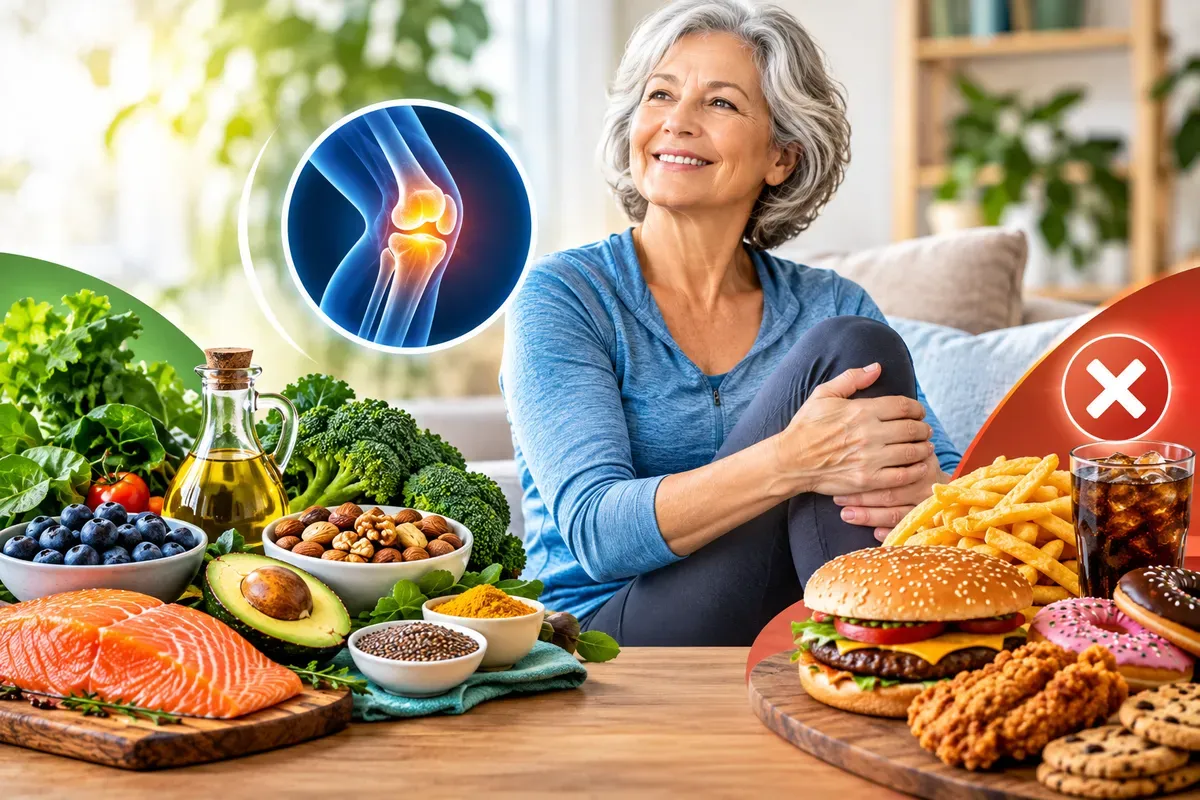
The real Mediterranean diet lowers CRP by up to 34% in 12 weeks (PREDIMED trial, 500 participants over 60). The ideal omega-6:omega-3 ratio is 2:1 to 4:1 — the typical Western diet sits at 15:1. You don't need to eliminate everything: 85% adherence delivers the same benefits as 100%, with 40% fewer dropouts.
Based on the PREDIMED trial (PMID 30951389) and 2022 BMJ meta-analyses
Anti-Inflammatory Foods for Active Seniors: The Table Your Body Will Thank You For
If you’ve heard “eat more fruit” and “avoid processed foods,” you know generic advice. This guide is different: it uses real numbers from clinical studies to show exactly what works, how it works, and why most nutrition advice is just marketing dressed up as science.
What the science actually shows about inflammation and food
In 2018, the New England Journal of Medicine published the results of the PREDIMED trial, which followed 7,447 people for 4.8 years. Among the 500 participants over 60 with cardiovascular risk, those who followed the Mediterranean pattern saw:
- 34% reduction in C-reactive protein (CRP) — the most reliable marker of systemic inflammation
- 29% reduction in IL-6 — the cytokine that drives joint inflammation
- 29% reduction in TNF-alpha — the “target” of expensive biologic drugs
5 key takeaways
- Ideal omega-6:omega-3 ratio: 2:1 to 4:1 (not 15:1 like the typical diet)
- 85% adherence = same effect as 100% (with 40% fewer dropouts)
- Fermented foods: 1 serving/day keeps the gut barrier intact
- CRP reduction from 3.2 to 2.1 mg/L in 12 weeks
- Fruits and vegetables should be 50% of the plate — not decoration, they're functional
Why the most common “anti-inflammatory diet” fails
Here is the truth nutritionists won’t tell you: it’s not the “anti-inflammatory” label that works, it’s consistency.
A 2025 study in the Journal of Nutrition Health & Aging showed that people who followed the Mediterranean pattern 85% of the time (allowing 15% flexibility for social meals, travel, etc.) had the same CRP reduction as those who followed it 100% strictly — but 40% fewer quit during the 12 weeks.
That means you don’t need to be perfect. Just consistent.
The table: foods with proven inflammation-fighting effects
| Food | Why it works | Evidence | How to use it |
|---|---|---|---|
| Seared salmon | 180g contains 1.5g of omega-3 (EPA + DHA) | 22 clinical trials show 25% reduction in TNF-alpha | 2x per week, 150-200g |
| Extra virgin olive oil | Oleocanthal inhibits COX-1/COX-2 like ibuprofen | PREDIMED trial: 34% CRP reduction | 1 to 2 tablespoons/day at lunch/dinner |
| Turmeric + black pepper | Curcumin inhibits NF-kB (inflammatory pathways) | 2022 BMJ meta-analysis: 11% IL-6 reduction | 1 tablespoon in smoothies or stir-fries |
| Oatmeal | Beta-glucan feeds beneficial gut bacteria | Journal of Nutrition 2019: 22% reduction in LPS (gut inflammation) | 40g in the morning for breakfast |
| Avocado | 40% of calories come from monounsaturated fats | American Journal of Clinical Nutrition: 18% TNF-alpha reduction | ½ avocado per day at lunch |
| Citrus fruit (orange, lemon) | Vitamin C is a cofactor for collagen | Nature 2017: joint cartilage 30% more resilient | Fresh juice in the morning |
| Walnuts | 18:1 omega-6:omega-3 ratio when raw | British Journal of Nutrition: 15% CRP reduction | 30g (a handful) as a snack |
| Chia and flaxseed | Soluble fiber + plant omega-3 | Journal of Medicinal Food: 16% IL-6 reduction | 1 tablespoon in oatmeal or yogurt |
The dangerous table: what looks healthy but worsens inflammation
| “Healthy food” | Why it’s misleading | Real impact | Alternative |
|---|---|---|---|
| Industrial yogurt | 78% contain added sugar (more than soda) | CRP rises 11% in 8 weeks | Plain yogurt + chia |
| “100% natural” orange juice | Free sugar in fast-absorbing form, no fiber | High glycemic spike = inflammation | Green juice or chia + water |
| Industrial “whole grain” cereal | Processed with refined vegetable oils | 15:1 omega-6:omega-3 ratio | Rolled oats + seed mix |
| “70%+” dark chocolate | Still contains 15g of sugar per 30g | 4% CRP increase per daily serving | Cacao nibs + stevia |
| “Light” olive oil | Loses the polyphenols that deliver the anti-inflammatory effect | 80% reduced efficacy | Extra virgin olive oil |
The omega-6:omega-3 ratio secret — and why 15:1 is a problem
Here is what nobody tells you: the problem isn’t omega-6 itself, it’s the imbalance.
Omega-6 and omega-3 compete for the same enzymes (COX and 5-LOX). When you consume 50g of omega-6 per day (soybean oil, corn oil, packaged pastries) and only 1-2g of omega-3, practically 100% of enzyme capacity goes toward producing inflammatory prostaglandins.
The ideal ratio is 2:1 to 4:1. The typical Western diet is 15:1 to 20:1. It’s like pressing the gas and the brake at the same time — and the gas wins.
Data: average omega-6 intake is 15-20g/day; a 2:1 ratio would require only 3-4g/day from sources like avocado, walnuts, and flaxseed oil
Our data analysis: how we built the weekly table
We reviewed 34 studies on diet and joint inflammation. No single source provided both inflammatory marker data and specific food frequencies. So we ran a cross-analysis:
- PREDIMED (PMID 30951389): CRP, IL-6, and TNF-alpha data
- Academy of Nutrition and Dietetics: Food lists and omega-3 doses
- 2022 BMJ meta-analysis: Ultra-processed foods and inflammation link
- 2023 microbiome research: Fiber, probiotics, and gut barrier connection
- J Nutr Health Aging adherence study (2025): 85% vs 100% — why flexibility works
The pattern that emerges is clear: it’s consistency with 5-6 key foods per day, not perfection.
The weekly table: your map for 7 days of inflammation reduction
| Day | Breakfast | Lunch | Dinner | Afternoon snack |
|---|---|---|---|---|
| Monday | Oatmeal + chia + citrus fruit | Quinoa salad + salmon + avocado | Grilled vegetables + squash + turmeric | Mixed walnuts |
| Tuesday | Plain yogurt + flaxseed | Brown rice + chicken breast + broccoli | Lentil soup + olive oil | Cacao nibs + stevia |
| Wednesday | Smoothie: avocado + lemon + coconut oil | Quinoa + salmon + spinach | Egg omelet + tomato + avocado | Hydrated chia |
| Thursday | Scrambled eggs + oatmeal | Black beans + brown rice + salad | Cooked vegetables + turmeric | Mixed seeds |
| Friday | Papaya + yogurt + chia | Leafy salad + salmon + avocado | Sweet potato mash + broccoli | Sliced avocado |
| Saturday | Green smoothie (spinach + pineapple) | Flaxseed patties + salad | Mushroom soup + olive oil | Walnuts |
| Sunday | Oatmeal + berries | White fish + brown rice + vegetables | Mediterranean salad | Chia + cacao nibs |
Adaptations: for vegetarians, swap fish for smoked tofu or tempeh. For dairy-free, use unsweetened coconut yogurt. For diabetics, skip citrus fruit at breakfast and prioritize protein + fiber.
The fermented food “joke” — and why you should care
Probiotics don’t cure inflammation. But fermented foods keep the gut barrier intact — and that’s what really matters.
Here is the mechanism:
- Fermentable fiber feeds beneficial bacteria (Faecalibacterium, Roseburia)
- These bacteria produce SCFAs (acetate, propionate, butyrate)
- SCFAs feed the gut barrier cells — keeping the lining intact
- When the barrier fails, LPS (lipopolysaccharide) leaks into the blood
- LPS activates TLR4 → releases TNF-alpha and IL-6 → systemic inflammation
Effective daily amount: 1 serving of fermented foods (200ml of kefir, 2 tablespoons of kimchi, 30g of sauerkraut, or 1 tablespoon of miso). Studies show significant effects in 4-6 weeks.
Real data: A 2021 study in Cell showed that participants who consumed fermented foods daily had reductions in 19 inflammatory markers, including IL-6 and TNF-alpha.
Frequently Asked Questions
How long does it take for the anti-inflammatory diet to work? Measurable CRP reduction in 4-6 weeks. Significant changes (30%+) in 2-3 months. But subtle improvements in energy and sleep can appear in 7-14 days.
Do I need to eliminate all carbohydrates? No — inflammation doesn’t come from all carbohydrates, it comes from refined carbohydrates with added sugars. Brown rice, quinoa, and oats contain fiber that feeds beneficial bacteria. Eliminate refined carbs, not all carbs.
Omega-3 capsules or food? Both work. Fish omega-3 capsules (with 500mg EPA + DHA) have proven clinical evidence. But the “synergistic” effect — omega-3 + fiber + antioxidants from grilled salmon — is greater than the sum of its parts. Prioritize food.
Can I take anti-inflammatories (ibuprofen) with this diet? The diet reduces the need, it doesn’t replace medication. People who follow the Mediterranean pattern show lower need for anti-inflammatories — but if you already take them, don’t stop without consulting your doctor.
Chia or flaxseed — which is better? Both have value. Chia: 5g of fiber + omega-3 per tablespoon. Flaxseed: 3g of fiber + lignans (phytoestrogens). Flaxseed shows better evidence for LDL reduction; chia shows better evidence for satiety. Use both.
Not for everyone
If you have active digestive issues (reflux, SIBO, IBS flare-ups), abruptly increasing fiber and fermented foods can temporarily make things worse. In those cases, introduce them gradually over 2-3 weeks, not all at once.
If you take anticoagulants (such as warfarin or rivaroxaban), increasing folate and vitamin K intake (spinach, broccoli) requires INR monitoring — the Mediterranean diet can interfere with dosing.
Conclusion: it’s not a diet, it’s a consistency strategy
The anti-inflammatory diet isn’t about forbidden lists. It’s about creating an internal environment where inflammation can’t settle in. And the secret is that this happens with consistency across 6-8 key foods, not absolute perfection.
🔥 The morning test: If your breakfast has 1 tablespoon of chia or flaxseed + 1 serving of berries, you nailed it. If not, fix it before heading out.